
★★★★★ rated by Anchorage homeowners and HOAs on Google
Roof avalanches aren't a theoretical risk here. The Municipality of Anchorage's building-safety guidance states plainly that falling roof snow and ice has caused fatalities in Anchorage, that a metal roof "can avalanche the entire snow load in an instant, without warning" — and it recommends exactly two responses for the area below a sloped metal roof: install snow guards, or block off the area all winter.
There's a structural side too. The same guidance flags buildings built before 1990 — before Anchorage's code required roofs to be designed for drifting snow — as the ones that fail. Most local roof failures involve wood trusses from that era, often at loads below today's code minimum, and the Municipality advises removing heavy drifts from those roofs all winter unless a structural engineer has cleared the structure. That's why our assessment starts with the building, not the product: holding snow on a roof only makes sense if the roof can carry it, so on older buildings we check the structure first — and bring in an engineer when it's in doubt.
We'd rather your walkway stayed open. A properly engineered retention system holds the snowpack in place so it leaves your roof the safe way: as water, through your drainage path — not as a quarter-ton slab.
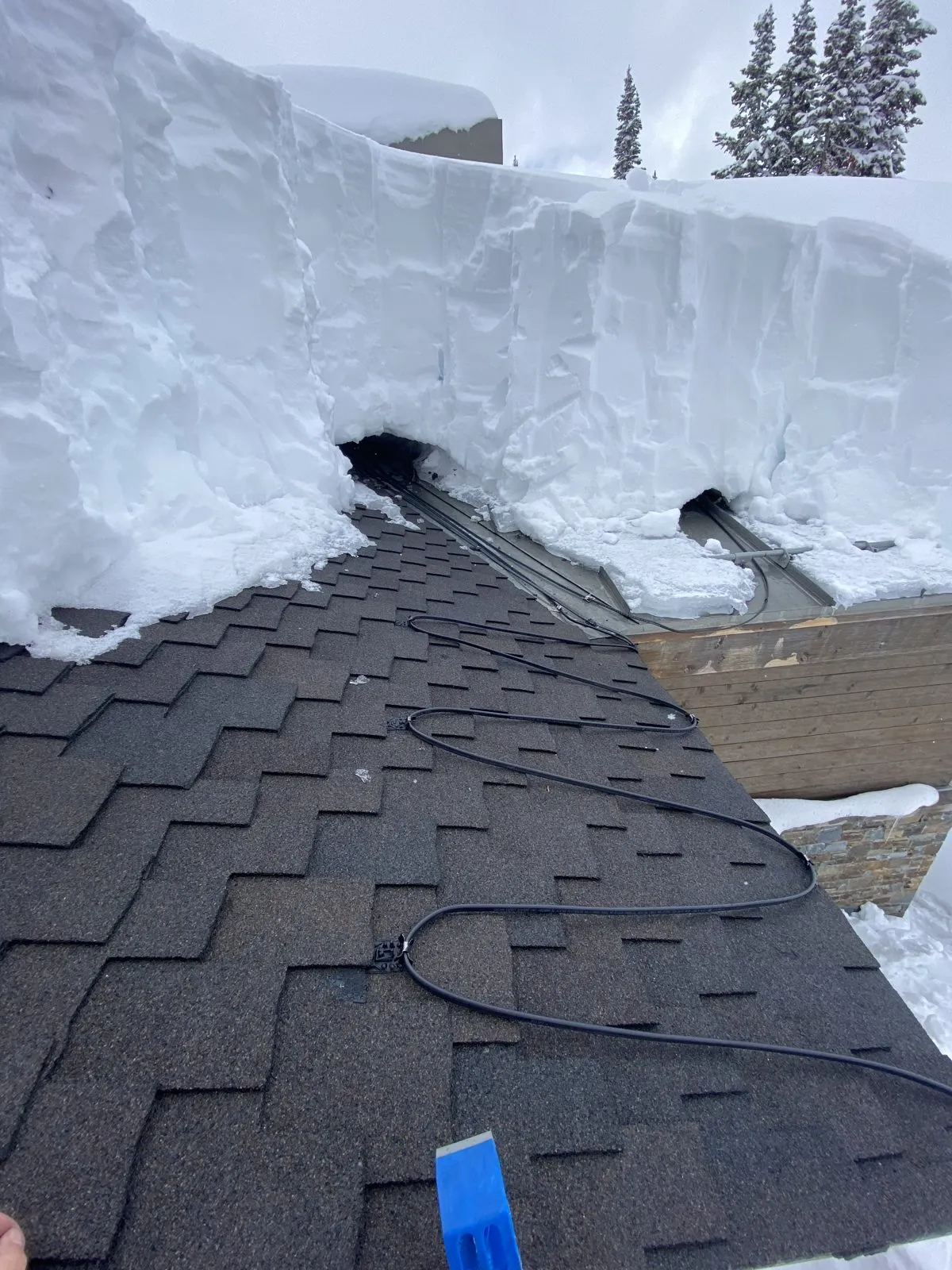 A winter's snowpack leaves a roof one of two ways — engineered, or all at once
Snow retention only works when there's enough of it, in the right places. The load it has to hold is a calculation — your roof's snow load, pitch, and the length of roof feeding each row — not a guess. Anchorage roofs are designed around a 50-pounds-per-square-foot ground snow load, and it climbs from there: higher elevations on the Hillside add load with every hundred feet, and Girdwood carries nearly three times the Anchorage base.
So we don't eyeball it. For every job, we run your roof's measurements through the manufacturer's engineering — and the layout that comes back determines how many rows you need and exactly where they go. That layout goes in your job file, and you get a copy. It's the difference between a system designed to hold your roof's snow and a row of parts that looks like one.
One thing we won't do: install a single "courtesy row" at the eave. An under-built system implies protection it can't deliver — when the pack releases, it goes over or through it. If a roof needs four rows, the honest quote says four rows.
Different roofs hold snow guards differently, and using the wrong attachment is how systems fail. We match the system to the roof:
Clamp-mounted rail systems that grip the seams without a single hole in the panel. The clamps pinch the seam; they don't pierce it — your panels keep their finish and their warranty.
Face-mounted brackets, mechanically fastened through the panel into solid backing with gasketed roofing screws, sealed at every penetration.
Bar and pad systems fastened through the shingle into the roof deck itself, with the mounting strap tucked under and waterproofed by the shingle course above. Never surface-attached, never shingle-only — the deck is what carries the load.
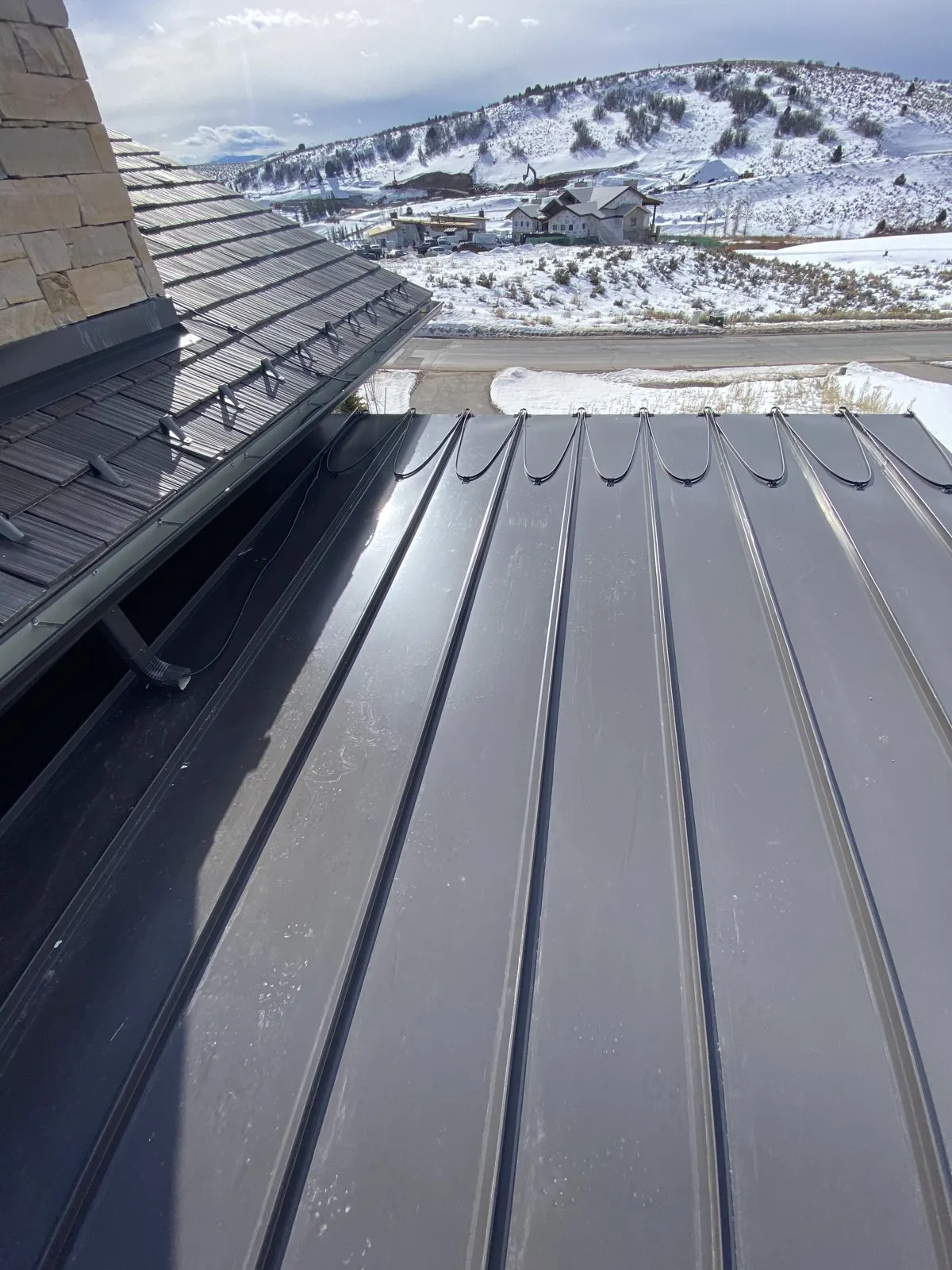
Fair question. Our heat cable standard is zero penetrations: every cable clip is glued, because cable clips carry almost no load and your roof doesn't need holes for them.
Snow retention is the opposite problem. A retention row can be asked to hold thousands of pounds of snow — and every engineering authority in the roofing industry, plus the manufacturers' own load testing, says the same thing: structural loads need mechanical attachment. Glued-on snow guards hold a fraction of what a fastened system holds, and Anchorage's snow loads are beyond what adhesive systems are even rated for.
So the principle is the same one, applied honestly: the attachment matches the load. No-load cable clips get glue and zero holes. Load-bearing snow retention gets engineered mechanical attachment — fastened right, gasketed, and sealed, so it holds for the life of the roof without leaking.
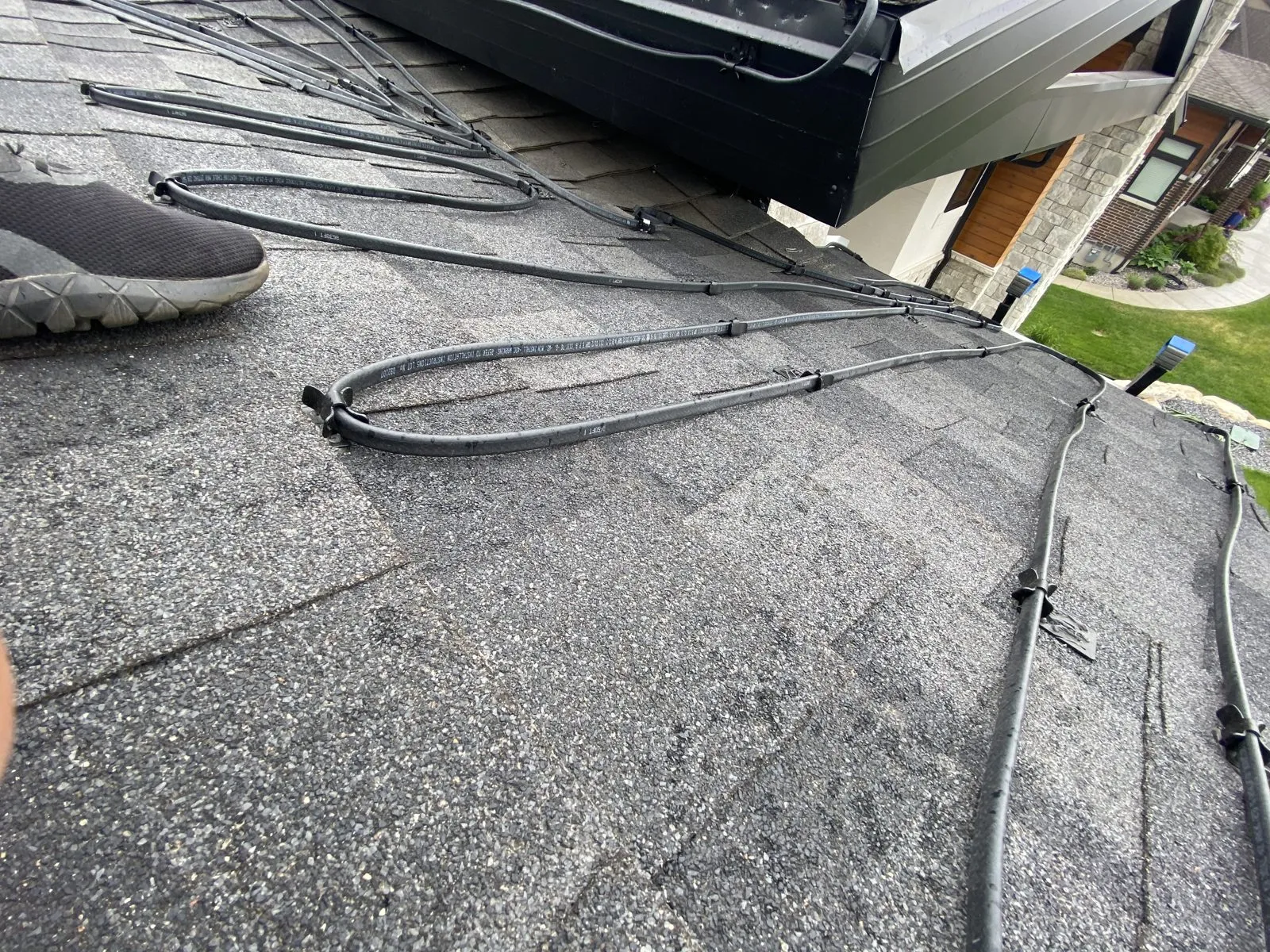 No-load cable clips: glued. Load-bearing retention: engineered fasteners.
On a slick roof, these two protect each other:
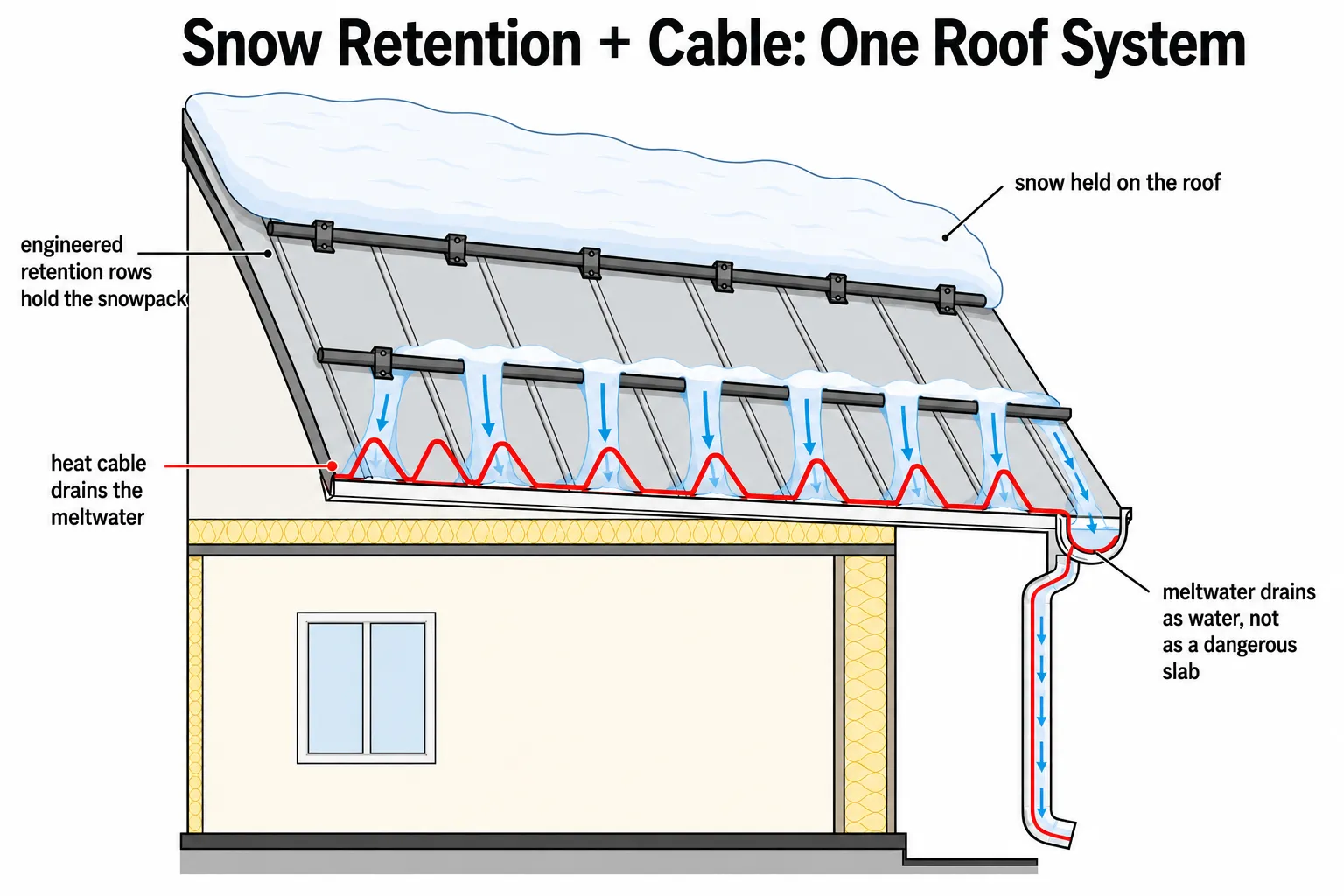
A roof avalanche doesn't just threaten what's below — it can shear off heat cable and gutters on its way down. Retention rows above the eave hold the pack so your de-icing system survives the winter it was built for.
A retained snowpack still melts from underneath. Heat cable at the eaves, valleys, and downspouts gives that meltwater a path off the roof — without it, held snow can feed the very ice dams you're trying to prevent.
That's why we design them together: retention rows up-roof, cable managing the drainage path below. If you're getting heat cable on a metal roof, we'll tell you honestly whether it needs retention above it — and if you only need one of the two, we'll tell you that too.
Roof type, pitch, measurements, elevation, and what's below your eaves. We also check the things most installers skip: whether your roof was engineered to shed its snow (some metal buildings are — retention on those needs an engineer's sign-off first) and whether the structure is suited to holding a retained snowpack.
Your measurements go through the manufacturer's engineering; you get a quote built on the returned layout, with the row count and placement shown, not implied.
The right attachment for your roof type, every penetration gasketed and sealed, installed to the manufacturer's spec so their warranty stands behind it.
Photos of the attachment points, the completed rows, and the finished field, stored with your layout in your job file.
A properly engineered system holds the snowpack so it melts and drains instead of releasing as a slab. No snow retention system can promise 100% effectiveness — the industry's own engineering standard says exactly that, and you should be skeptical of anyone who claims otherwise. What engineering changes is the odds: a calculated layout holds the load it was designed for; a decorative row doesn't.
It depends on the length of roof feeding each row, your roof type, and your snow load — which is why we run the engineering before we price. The quote shows the layout you're paying for. Retention is often bundled with a heat cable install, and it's significantly cheaper than the deck, gutter, or vehicle damage a single slide can cause.
On standing seam, nothing is pierced at all — the clamps grip the seam. On shingle and corrugated roofs, every fastener lands in solid backing, gasketed or sealed, and installed to the manufacturer's published spec — which is what keeps their warranty behind the system. We photograph the attachment work so you have the record.
Usually, yes — retrofit systems exist for shingle and metal roofs, and adding retention doesn't require a re-roof. If the slide took your heat cable or gutters with it, we can rebuild the system as one design so it doesn't happen twice.
On slide-prone roofs — metal especially — often yes, because a slide can destroy the cable system. On roofs that hold their snow, often no. We'll tell you which one yours is at the assessment; we don't quote retention where it isn't earning its keep.
Girdwood's design snow load is nearly three times Anchorage's — it's a different class of system: heavier continuous rails, denser rows, and manufacturer engineering on every job, sometimes with a structural check first. We quote it accordingly.
Free on-site assessment. Engineered layout with every quote.
★★★★★ on Google · Engineered to your roof's snow load · Serving Anchorage, Eagle River, Girdwood & Wasilla