
★★★★★ rated by Anchorage homeowners and HOAs on Google
It depends on your roofline, drainage paths, and electrical setup — which is why we measure before we price. Every quote from Alaska Heat Cable includes a diagram of exactly what you're paying for, and financing options are included in the bid. We're not the cheapest option in town, on purpose. Part of what you're paying for is the crew. Roof work sits at the top of the rate scale for insuring construction labor in Alaska, and carrying a crew for it costs real money before anyone sets foot on your roof. That cost is in our number instead of being left out of it. The rest is commercial-grade self-regulating cable, glue-only attachment, licensed electrical work, testing, and documentation.
It depends on the length of roof feeding each row, your roof type, and your snow load — which is why we run the engineering before we price. The quote shows the layout you're paying for. Snow retention is often bundled with a heat cable install, and it's significantly cheaper than the deck, gutter, or vehicle damage a single roof slide can cause.
Yes — the assessment and the quote cost nothing, and there's no obligation. We come out and look at the whole roof: we drone-map it, take measurements, trace where meltwater actually goes, and check your electrical capacity. Then you get a quote with a diagram showing exactly where cable would run or where snow retention would land, what it costs, and why we designed it that way. If your roof doesn't need what you called about, we'll tell you that too.
Usually because the two bids aren't describing the same work. Ours includes commercial-grade self-regulating cable rather than the cheapest cable that fits, a layout designed to your roof's actual drainage instead of a straight run along the eave, glued clips instead of fasteners through your roofing, licensed electricians on all electrical work, system testing, and documentation you keep — plus insuring a crew for winter roof work, which is one of the largest line items behind any honest bid in this trade. We'll walk you line by line through what's in ours — and what to ask the other bidder about theirs.
Look for the detail: does the bid say exactly where cable runs, how each power source is handled, what testing is done, and what documentation you receive? We recommend asking every bidder for that in writing — it's the fastest way to see what a lower number leaves out. Boards and property managers in particular should ask whether the bid covers the whole roof or only the sections that were easy to reach.
Yes — financing options come with the bid, in writing, so you can see the monthly figure next to the total before you decide. You don't have to ask for it or apply first; it's part of the quote.
It keeps the drainage path open so meltwater gets off the roof instead of ponding behind ice and backing up under your roofing — that's the real job description, and on most roofs it's exactly the protection needed. What heat cable won't do: remove snow, heat your whole roof, or fix the attic heat loss driving the melt. We'll tell you at the assessment which of those your roof actually needs — sometimes the answer includes things we don't sell.
Self-regulating cable varies its own heat output based on the temperature of the surface it's touching — colder spots put out more, warmer spots put out less — and it can be cut to length in the field and cross over itself without overheating. Constant-wattage cable puts out the same heat everywhere regardless of conditions, can't be cut to fit your roof, and one damaged spot can kill the entire run. Alaska Heat Cable installs commercial-grade self-regulating cable as standard. It's the more expensive product, and it's the reason our systems get designed to the roof instead of stretched along the eave.
Quality matters more than any number here: the self-regulating cable we install is a commercial-grade product, and yours is registered for its 10-year manufacturer warranty — that's the number that's backed in writing. Our workmanship warranty covers the installation itself.
Two things keep it from running away with your bill. First, self-regulating cable draws less power as the surface it's on warms up, so it isn't heating at full output all winter the way constant-wattage cable does. Second, we install a controller that only energizes the system when it senses both cold and moisture — meaning it's off during a dry cold snap, when there's nothing to melt. What it actually costs depends on your system's total connected wattage and how often winter conditions trigger it, and we can tell you your system's wattage as part of the quote so you can do the math on your own utility rate instead of taking a number on faith.
No — that's what the controller is for. A sensor-driven controller runs the system on conditions, not on the calendar: no fall and spring service calls, no one on the property responsible for remembering. It's the configuration most HOA boards choose once they see the ten-year math, and most homeowners prefer it too.
You can — and many of our customers did, before calling us. Store-bought cable is usually constant-wattage: one damaged spot kills the whole run, it can't be cut to fit your roof, and it wasn't designed for Alaska winters. If it worked well, we'd have far fewer customers.
Our standard method puts zero holes in your roof — every clip is glued, not screwed. That matters most on membrane roofs (EPDM, torch-down), where penetrations become leak points. If your roof ever requires a fastener, you'll know why and sign off first.
It stops the leaks ice dams cause: water backing up behind the ice and under your shingles. It can't fix a roof that's already letting water in. The cable keeps meltwater moving, and that water crosses your roofing on its way to the gutter — so worn shingles, damaged flashing, or a poorly installed roof can still leak. If your roof has leaked before, tell us up front. We'd rather talk it through before we install than after.
Licensed electricians install all electrical work on every job — that's standard, not an upgrade. Roof deicing has its own section of the electrical code (NEC Article 426, which Alaska has adopted), including a ground-fault protection requirement specific to this equipment. It's not general-purpose wiring, and we don't treat it that way.
It's our specialty. We diagnose your actual electrical capacity before designing anything, licensed electricians install all electrical work, and where power is genuinely limited we can build custom controllers that protect the full roof within the capacity you have — instead of telling you to pay for a service upgrade.
Yes — it's built to be energized continuously, and leaving it on won't hurt the system. But it will cost you money for nothing on the days there's nothing to melt, and that's the real reason not to. Roof de-icing has its own section of the electrical code (NEC Article 426), which requires ground-fault equipment protection on these circuits specifically, because ordinary breakers don't reliably stop the kind of arcing a damaged heating cable can produce. That protection is what makes continuous operation safe, and it's on every system we install. The judgment call is economic, not safety: run it when snow and melt are happening, and let it rest during dry cold, when it's heating your roof edge for no benefit. A sensor controller makes that call for you.
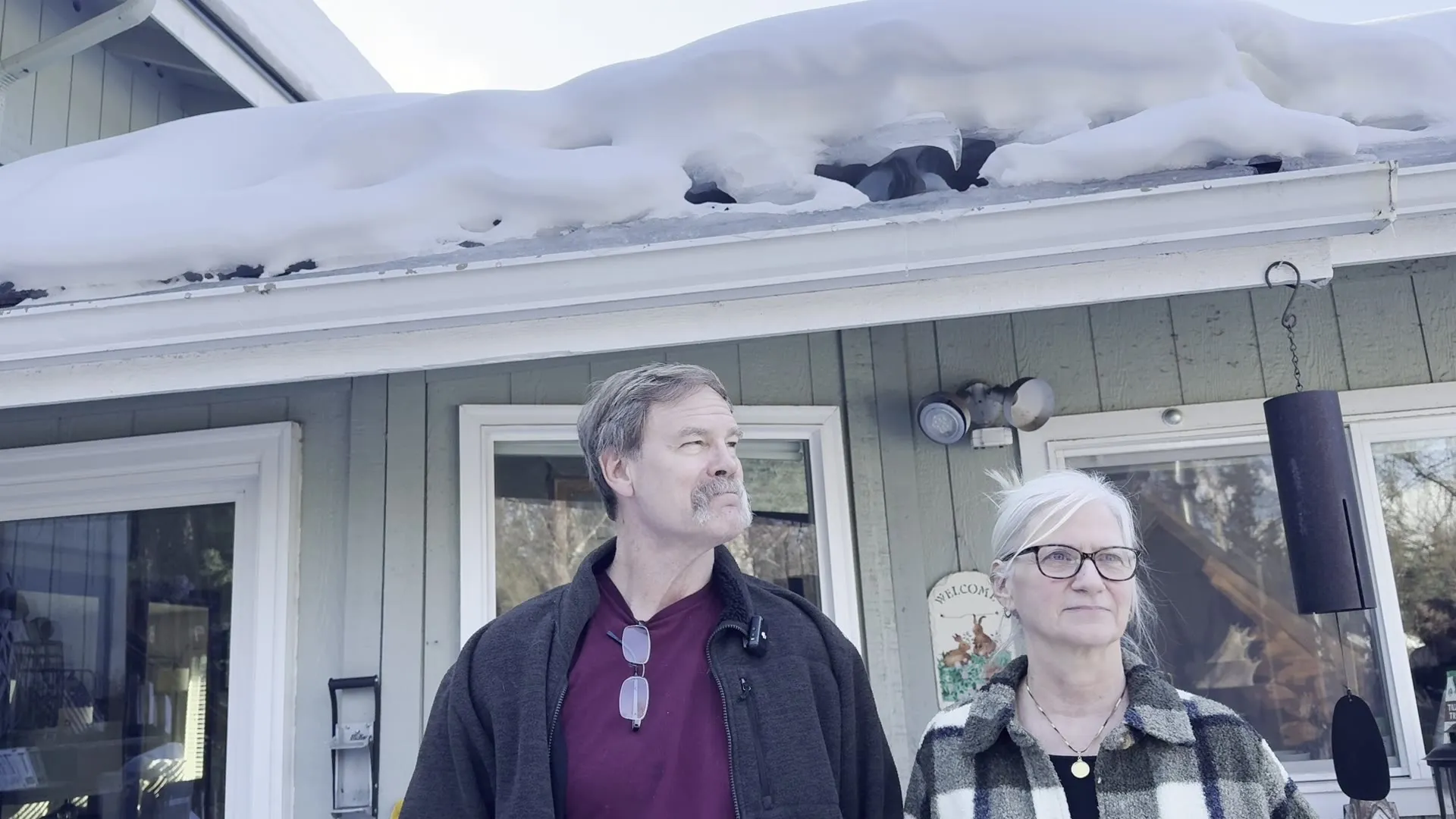
Look for drainage, not heat. A working system shows melted channels through the snow along the cable runs — paths, not a bare roof — and water making it to the gutter, the downspout, or the ground. In a valley the channel can tunnel underneath the snow where you can't see it from the driveway. If your controller has an indicator light, it shows when the system is powered. What you should not rely on is touch, which is the test most people reach for first. Our full owner's guide walks through the two-minute check.
Not necessarily — and this is where homeowners most often conclude a working system is broken. Self-regulating cable runs warm, not hot, and in freezing weather the cable surface may be only slightly above freezing itself. A cold hand can easily miss it. Manufacturers' own operating manuals list "may feel warm" as one possible indicator among several, not as a test. Judge the system by whether water is draining, not by how it feels.
The self-regulating cable we install limits its own temperature by design — it can't run away the way a fixed-output cable can, and it's rated to a maximum sheath temperature well below ignition for roofing materials. The real risk in this product category isn't a working cable; it's a damaged one, where the jacket has been cut, crushed, or pulled apart and can arc. That's exactly why the electrical code requires ground-fault equipment protection on de-icing circuits, and why we tell every customer the same thing: if your ground-fault breaker trips once, reset it; if it trips again right away, leave the system off and call us. A breaker that keeps tripping is doing its job.
There's no honest way to answer that from the ground, and any calculator that gives you a number from your roof's square footage is guessing. The length is set by where meltwater actually travels on your roof: the eave runs have to extend up-roof past the exterior wall line into the warm zone, valleys need their own runs, and the path has to continue through the gutter and down inside every downspout to discharge — a system that melts water at the eave and lets it refreeze in the downspout has just moved the dam. That's why we measure, drone-map, and trace drainage before we price anything, and why your quote comes with a diagram of exactly where cable would run.
Different attic, different roofline, different exposure. More ceiling air leaks, a valley or dormer concentrating meltwater, a hot roof, or a sunny southern exposure can put a dam on your house while the same storm leaves your neighbor's alone. It's the roof, not the winter. More on how they form →
Call and tell us what's happening — active water intrusion gets prioritized ahead of everything else on the schedule. If water is coming into your house, we will pull a crew off a scheduled heat cable install to get it stopped; a leak can't wait and an install can. Alaska Heat Cable also runs two steamer units, which means two crews' worth of emergency capacity in the same week. After-hours and emergency work does carry an additional charge.
Steam removal is specifically the method that doesn't. No striking, no prying, no pressure-washing — the steam melts the bond between ice and roof and the ice comes off without force. It's the reason we invested in commercial steaming equipment instead of hand tools.
Please don't — falling ice and ladders on ice are how people get seriously hurt, and pulling icicles can bring the dam, the gutter, or you down with them. If ice is threatening an entryway right now, keep people away from it and call.
Policies vary — many cover interior water damage from ice dams but treat the removal itself differently. Check with your carrier; we provide documentation of the condition and the work for your claim either way.
After removal alone — very likely, yes. The dam is a symptom of how your roof loses heat and drains water; steaming doesn't change either. A heat cable system does. We'll show you exactly what that would look like for your roof, no pressure.
Attic heat loss is one of the root causes, and if yours has never been air-sealed, that work is worth doing — it can lower your heating bill too. Go in with eyes open, though: done properly, air sealing can be an expensive and time-consuming job — pulling back insulation, finding and sealing every leak, then re-insulating — and on a hot roof it can mean opening up finished ceilings. And it isn't a guaranteed fix for ice dams: even a fully air-sealed attic can leave the ice unchanged. Many Alaska roofs need both: deep snow, hot roofs, complex rooflines, and sun-driven melt can produce dams even over a well-built attic. We're straight with you about which case your house is.
Snow removal genuinely works — the Municipality of Anchorage calls removing roof snow before it melts and refreezes the most effective cure, and notes that clearing only the eaves usually isn't enough, because the melt is happening over your whole heated roof. The catches: it has to be done repeatedly all winter, raking can damage roofing, and winter roof work is dangerous — Anchorage's guidance points homeowners to professionals for a reason.
Not necessarily. Dams are a heat-and-water problem, not a shingle problem — even correctly installed roofing sheds flowing water but can't hold back standing water. That said, an eave membrane under the shingles (standard practice here) limits how much a dam can damage; it just doesn't prevent the dam.
Icicles alone aren't an emergency — they're the visible symptom of a process that may or may not be causing harm yet. What should get your attention, in rough order of urgency: ice forming behind the gutters (the dam is established), ice coming through the soffit (water is backing into the overhang), ice or water showing on an exterior wall, and water appearing at a door or window frame. Those last two mean water is already traveling inside your walls, often from a roof-edge problem some distance away — by then it may have been going on a while. Water inside the house is a call-now situation; a growing ridge of ice at the eave is a call-this-week situation.
No — plenty of Anchorage roofs grow ice at the eave every winter and never leak. Damage depends on whether water actually ponds behind the dam and finds a path in. Roofing is built to shed water flowing downhill, not to hold back standing water, so the risk rises with how much water pools upslope of the ice and how long it sits there. A low-pitch roof needs surprisingly little ice to pond water. An eave membrane under the shingles, standard practice here, limits how far a dam can get. The honest version: the dam is a risk indicator, not a verdict — but it's a risk that compounds every melt-freeze cycle, and the damage is usually invisible until it isn't.
No. Dams form with or without gutters, because the dam is made on the roof by heat loss, not at the gutter line. But gutters full of ice bring real risk of their own: ice weighs roughly 60 pounds per cubic foot, which is enough to tear a gutter off the house. And a gutter or downspout packed with ice defeats a heat cable system that would otherwise be draining the roof, which is why our layouts run cable through the gutter and down inside the downspout to discharge.
A badly designed system can, and it's worth understanding why before you buy one. If cable melts water at the eave but the drainage path doesn't continue all the way to the ground — no run through the gutter, nothing inside the downspout — the meltwater simply refreezes further along and the dam relocates. Running a system in extreme cold can do something similar, producing just enough melt to refreeze rather than drain. That's a design-and-operation problem, not a product problem, and it's the main reason we design to the roof's actual drainage instead of stretching cable along the eave.
Usually not, and that surprises people. Roofing warranties cover defects in materials and workmanship — an ice dam isn't a defect, it's water behaving the way water behaves when your roof loses heat. A correctly installed roof can still get a dam. Homeowner's insurance is the more relevant question for the damage itself: policies vary, and many cover interior water damage from ice dams while treating the removal work differently. Check with your carrier; we provide documentation of the condition and the work for your claim either way.
A properly engineered system holds the snowpack so it melts and drains instead of releasing as a slab. No snow retention system can promise 100% effectiveness — the industry's own engineering standard says exactly that, and you should be skeptical of anyone who claims otherwise. What engineering changes is the odds: a calculated layout holds the load it was designed for; a decorative row doesn't.
On standing seam metal, nothing is pierced at all — the clamps grip the seam. On shingle and corrugated roofs, every fastener lands in solid backing, gasketed or sealed, and installed to the manufacturer's published spec — which is what keeps their warranty behind the system. We photograph the attachment work so you have the record.
Usually, yes — retrofit systems exist for shingle and metal roofs, and adding retention doesn't require a re-roof. If the slide took your heat cable or gutters with it, we can rebuild the system as one design so it doesn't happen twice.
On slide-prone roofs — metal especially — often yes, because a slide can destroy the cable system. On roofs that hold their snow, often no. We'll tell you which one yours is at the assessment; we don't quote retention where it isn't earning its keep.
Yes, substantially. Girdwood's design snow load is nearly three times Anchorage's — it's a different class of system: heavier continuous rails, denser rows, and manufacturer engineering on every job, sometimes with a structural check first. We quote it accordingly.
Pitch alone doesn't decide it — what's underneath does. The Municipality of Anchorage's own building-safety guidance is blunt about this: falling snow and ice has caused fatalities in Anchorage, metal roofs can release their entire snow load "in an instant, without warning," and areas below sloped metal roofs need protection — either snow guards to retain the snow, or the area blocked off. So the real questions are what the roof is made of, how much snow it feeds, and what's below it: an entry door, a walkway, a parking spot, a gas meter, a deck. A steep metal roof shedding onto a back corner nobody walks through may need nothing. A moderate metal roof over the front entry needs an engineered system. We'll tell you which one you have.
Both work when they're engineered; neither works as decoration. On standing-seam metal we generally use a seam-clamped continuous rail, because it grips the seam without piercing the panel at all — nothing penetrates, and the panel manufacturer's warranty stays intact. Continuous rail also dominates on high-load roofs like Girdwood's, where individual pads would have to be packed impractically dense. Deck-fastened pad fields are the standard approach on asphalt shingle. The choice follows the roof material and the calculated snow load, which is why we run the engineering before quoting rather than picking a product first.
Most heat cable installs are a two-visit job, and start to finish it can be as quick as about a week. The reason for two visits is the same thing that keeps holes out of your roof: because every clip is glued rather than drilled, the adhesive has to cure before cable goes on it — roughly three days in summer, about a week in winter. The first visit is surface prep and clip setting; the second is cable routing, electrical work, full testing, and the walkthrough. Winter installs can run longer: if ice forms on the roof between the two visits we steam it off before the cable goes on, and on some jobs that happens twice.
Before the snow flies. Summer and fall installs mean your system is tested and running before the first melt-refreeze cycle — and you're not booking emergency work in January. If you already have a dam and water inside now, steam removal comes first, then prevention.
Yes — year-round, including mid-winter. If you already have an active ice dam, we can steam it off first, then install the system that keeps it from coming back.
Anchorage, Eagle River, Girdwood, and Wasilla. Girdwood jobs are engineered to Girdwood's snow loads, not Anchorage's — the difference matters enough that we treat it as its own design case.
Yes — multi-building properties, entryway ice, and walkway hazards are a big part of our winter work, alongside coordinated scheduling and proposals a board can actually evaluate. See our commercial work.
Yes — that's the normal case. We schedule around entryways and parking, keep sites clean, and communicate through your property manager so residents hear what they need to hear and nothing else.
We've replaced a failed system across a 23-unit property in about three weeks of installation after it was discovered weeks before winter. We install year-round, and if ice is already forming we can steam it off while the permanent system goes in.
Two separate warranties. The cable itself carries a 10-year limited manufacturer warranty from Drexan, the manufacturer — and we register your installation with them, which is what makes that warranty valid. Separately, Alaska Heat Cable warrants its own workmanship: 2 years on self-regulating installations. Full terms, including what they don't cover, are in your written warranty.
Yes, and it has to be — Drexan's 10-year warranty is only valid on installations registered with them. We handle the registration and the test records as part of closing out your job, not as something you have to chase down later.
Yes — that's the part we're most stubborn about. Before we leave, you'll know where the cable runs, how your controller decides to turn the system on, what normal winter behavior looks like on your roof, and what would actually be worth calling us about. You shouldn't have to trust a system you don't understand.
Call us. Your written warranty spells out how warranty issues are handled, and the documentation from your install — the layout diagram, the test records, the registration — is on file, so a service call starts from a record of what was built rather than from scratch.
Ask it. We'd rather spend twenty minutes explaining than have you buy something you don't understand — or don't need.
★★★★★ on Google · Serving Anchorage, Eagle River, Girdwood & Wasilla